Eating through the cycle, and what the evidence actually supports
For most of a year, before there was an app, my partner and I were adjusting our meals around their cycle by hand. Period dates in the calendar, a notes app full of lists scraped together from wherever the advice looked sensible: iron this week, sweet potato that week, peppermint tea for the bloating, no heavy sessions on the first couple of days. Some of it seemed to help a lot. Cutting sugar and caffeine in the run-up to a period made a difference we both noticed.
When I came to build that into Gentle Plate I had to decide what the app was allowed to say, which meant going and reading where each piece of advice came from. This post is what I found. The short version is that most of the food-by-phase advice online rests on very little, one thing rests on quite a lot, and the app is written so that you can tell which is which.
One line first, because it matters: nothing here or in the app is medical advice. If you have a condition, a diagnosis or a question about your own cycle, that is a conversation for a doctor, and the app will never try to have it for you.
The four phases, in plain words
If you have never looked into this, a cycle is the stretch from the first day of one period to the first day of the next, about four weeks for most people. The body goes through the same sequence each time, and the cycle-syncing advice splits that sequence into four phases. Here is what each one is, without the biology lecture:
- The period (menstrual). Day 1 is the first day of bleeding. Energy is usually at its lowest and cramps are common. Typically the first 3 to 7 days.
- The build-up (follicular). The stretch after the period, when the body is preparing to release an egg. Energy climbs. This is the phase that changes length from person to person and month to month.
- The peak (ovulatory). The few days around the egg being released, roughly the middle of the cycle. About 3 days.
- The wind-down (luteal). The two weeks after that. The body runs a little warmer and a little hungrier, and this is where PMS lives if you get it.
The app uses the same four, and it needs only one thing from you to work out which you are in: the first day of your most recent period, typed once in Settings. Until you type it, nothing about your cycle exists in the app and it never asks.
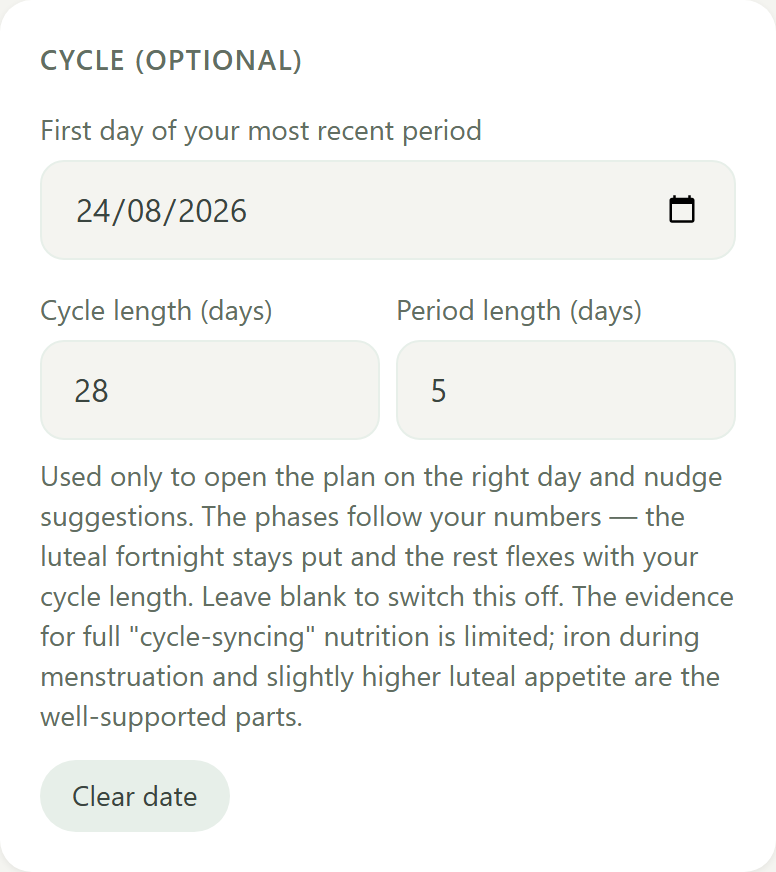
The one thing I learned about the boundaries whilst building this is that the four phases are not equal quarters, which is how most of the advice presents them. The wind-down is more like a fixed countdown: once the egg is released, the next period arrives about 14 days later whatever your cycle length. A longer cycle means a longer build-up before that, not everything stretched a bit. So the app pins the wind-down at 14 days and the peak at 3, takes the period length you gave it (default 5), and gives the build-up whatever is left. My first version had four seven-day weeks, and for a 28-day cycle that put roughly 12 of the 28 days in the wrong phase (as you may imagine, it also put half the luteal suggestions in the wrong fortnight).
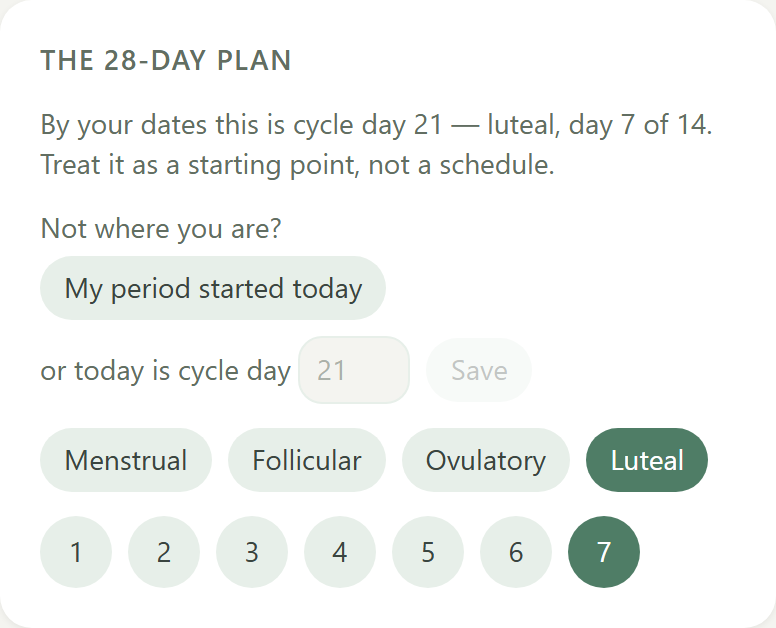
That is also why the Plan tab tells you which day it thinks you are on and gives you a one-tap way to correct it. Cycles do not keep to the calendar, and the app would rather be told than guess.
The one number that holds up
The claim I saw most often online is that you "burn 100 to 300 more calories a day" in the luteal phase. That one I could actually check, because two groups of researchers have gathered the controlled studies that measured it.
Benton and colleagues pooled every study they could find, going back decades (PLOS One, 2020). The body does tick over a little faster in the luteal fortnight in most of them, so the effect is real, but it is small, and when they looked only at the studies done since 2000, with better methods, it got smaller still and stopped being clear-cut. Hurtová and colleagues then reviewed the seven studies from 2020 to 2025 (Frontiers in Physiology, 2026) and put a size on it: roughly 30 to 120 calories a day, about 3 to 5 percent, which they note is small enough to overlap with the swing your resting metabolism makes from one day to the next for no reason at all. In food terms that is a banana, or a biscuit or two, rather than the extra meal the popular figure suggests. Think of it as a small tide under bigger waves: real, but easy to lose in the chop.
For the other three phases neither review found a change that stood out from the noise. I believe that is worth saying plainly, because a lot of the advice implies each phase has its own energy needs. On the evidence, one phase does, and by less than you would think.
The app takes the finding at face value. During the luteal fortnight your calorie aim widens upwards by 50 to 150, shown as a range rather than a new single number, with one quiet line underneath.
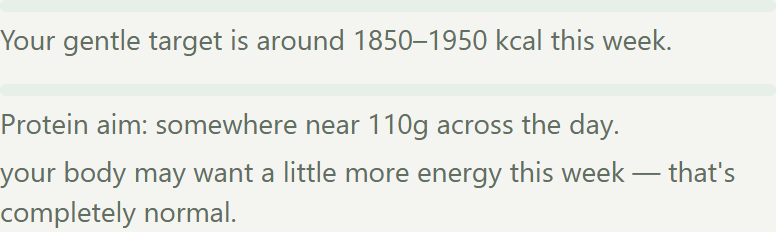
Outside luteal the aim stays exactly where you set it. I could have shown a single higher number, and it would have looked more authoritative, but it would be claiming a precision the studies do not have. A range is the honest shape for a 30-to-120 effect.
There is a second finding I found really useful for the app's tone. Rogan and Black gathered the studies on how much people actually eat across the cycle (Nutrition Reviews, 2023). Intake tends to run higher in the luteal fortnight and lowest around ovulation, and the authors are careful to say the size of that swing is not yet pinned down and varies from person to person and cycle to cycle. In other words, the extra hunger before a period is documented, even if nobody can tell you how big yours will be. So when you note "high appetite" or a craving in the app's private journal, the line it can show says this is one documented reason, and suggests slow-release carbs with some protein. It does not say the craving is a problem to be managed.
The foods, and how thin the ground is
This is the part I expected to be solid, and it wasn't. The phase food lists (iron-rich foods and vitamin C in the period week, oats and cruciferous veg in the build-up, berries and fermented foods around the peak, sweet potato and magnesium in the wind-down, seeds rotated by phase) are everywhere online, and they are what we were following in the notes app. When I went looking for controlled evidence that eating these foods in these weeks does anything, I couldn't find it. What I found was mechanism stories: this vegetable supports the liver, that seed supports this hormone. Plausible and unproven, and for the seed rotation I couldn't find a trial at all.
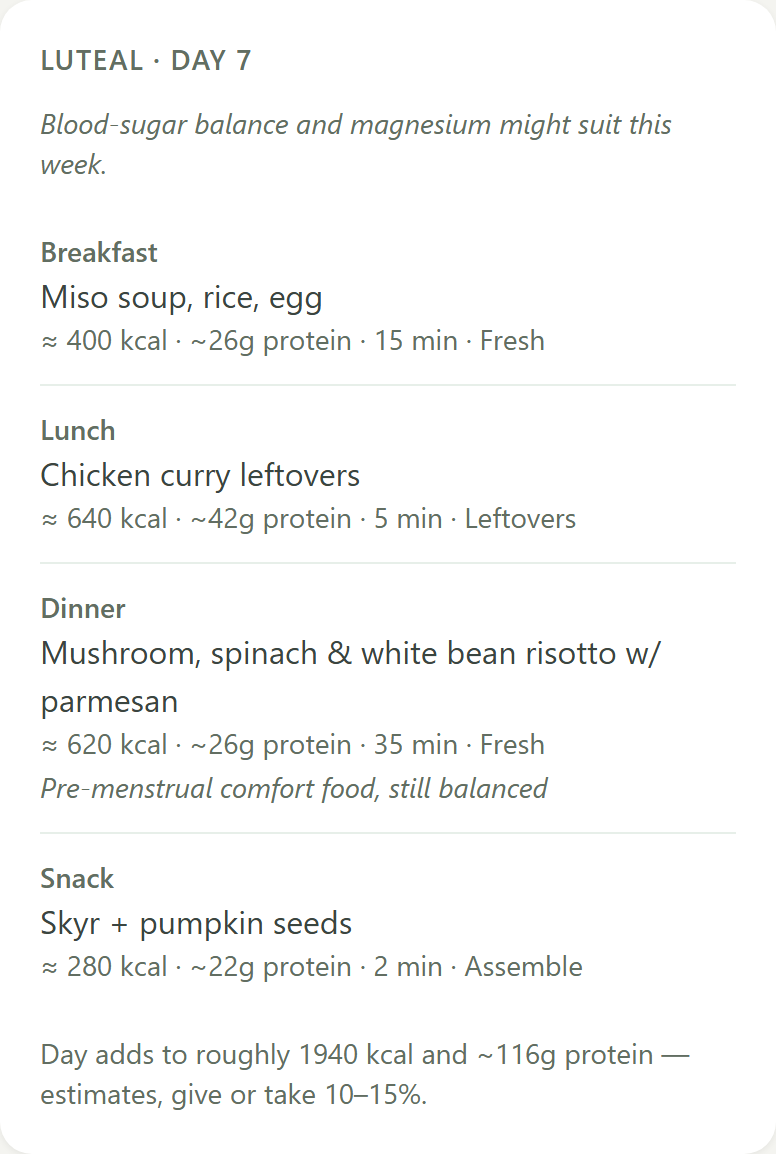
None of that makes the lists bad advice. Lentils, spinach, oats, berries, Greek yoghurt and squash are good things to eat in any week. It just means the app is not allowed to claim more than that. So the phase card on the Today tab says foods that "might suit this week", never that they will do anything, and the reference notes behind the app keep the food lists as reference material rather than as findings.
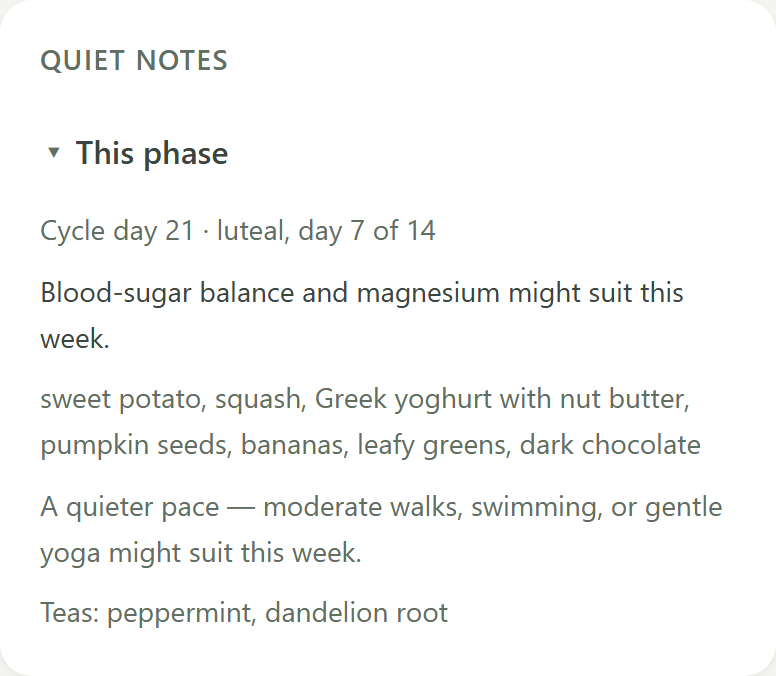
The same leaning shows up in the Plan tab, where each day's meals tilt towards that phase's foods, and in the Ideas tab, where a phase-fitting dish floats a little higher up the list. Tilt is the right word: nothing is filtered out, and a dish from the "wrong" phase is still one tap away.
The place I did find real evidence was narrower and more useful: not foods by phase, but specific things for specific symptoms. If you note a symptom in the app's private journal, it can show one short line beside it. Every one of those lines has a source and a stated confidence level, and the levels are honest:
- Period pain, modest. Exercise reduces pain in a Cochrane review (Armour and colleagues, 2019), though the authors rate the evidence low quality. Ginger powder beat placebo in a pooled analysis of four trials (Daily and colleagues, 2015), again small. A heating pad did at least as well as painkillers in three small trials (Jo and Lee, 2018). Magnesium rests on a handful of small trials in a Cochrane review from 2001 (Proctor and Murphy) that called it "promising" and is now old enough that I would not lean on it. That is the weakest leg of the four, and the line says "modest" because of it.
- Bloating, thin and borrowed. Peppermint's evidence is for peppermint oil capsules in irritable bowel syndrome (Alammar and colleagues, 2019), not for peppermint tea before a period. Smaller regular meals and fewer fizzy drinks are the lifestyle advice in the NICE guideline for IBS. Nothing here is menstrual-specific, and the line in the app says it is borrowed from gut research.
- Trouble sleeping, steady. Caffeine six hours before bed measurably cut sleep in a controlled study (Drake and colleagues, 2013), and a 2023 meta-analysis (Gardiner and colleagues) puts the cut-off for a standard cup of coffee at roughly nine hours before bed. So the line says early afternoon or so, which matches what we'd found by trial and error.
And some symptoms get no line at all, by decision: headaches, backache, breast tenderness, digestive upsets. Nothing food-shaped clears the bar for them, so the app notes them and says nothing. I believe an app that goes quiet when it doesn't know is worth more than one that has a tip for everything, even if it looks less clever.
The teas
Worth a short section of its own, because tea is where the advice gets most confident and the evidence gets thinnest. The app's phase cards list chamomile, ginger and raspberry leaf for the period week and peppermint and dandelion root for the luteal week, because those were on every list we found and my partner likes them. Of those, ginger has the pooled trials above (as a powder, at 750 to 2000 mg a day, which a cup of tea probably doesn't reach), peppermint has the IBS oil evidence, and for chamomile, raspberry leaf and dandelion root I couldn't find anything I'd put my name to. They are listed as things you might like, and that is all they are.
For what it's worth, and it is worth exactly one household's experience, my partner drinks raspberry leaf tea regularly towards the end of the luteal fortnight and into the period, especially once cramps start, and says it has helped a lot. Green tea through the whole cycle has helped them with bloating too. I am telling you that because it is true for us, not because it will be true for you, and it is not health advice. It is the kind of thing that goes in the notes app, and the app itself makes no claim about either.
Movement
The same advice sets pair each phase with a workout type: heavy lifting in the build-up, sprints around the peak, gentle yoga in the wind-down. The app carries a one-line movement note per phase in the same "might feel right this week" voice, and nothing more. I went through the evidence on that separately when deciding how the app should handle activity, and it deserves its own post, so it will be the next one. The short version is that consistency beat phase-matching on the evidence we could find, and the app is built around that.
What this means for you
If you set a cycle start date, the app will widen your calorie aim a little for the luteal fortnight and lean its suggestions towards some foods in each phase, and that is the whole feature. The widening is the one part backed by a proper review. The food leanings are the same popular advice you would find anywhere, labelled as suggestions, and the symptom lines each say how much to trust them. Nothing in the app sells a supplement, and nothing will ever tell you a food boosts your metabolism.
If you'd rather see it than read about it, the waitlist is on the front page. What the app stores about your cycle, and who can see it, is on the privacy page. And again: none of this is medical advice. It is two people's notes app, tidied up and checked against what the studies actually say.
References
- Benton MJ, Hutchins AM, Dawes JJ. Effect of menstrual cycle on resting metabolism: a systematic review and meta-analysis. PLOS One, 2020. doi.org/10.1371/journal.pone.0236025
- Hurtová A, Gimunová M, Beníčková M. Resting metabolic rate fluctuations across the menstrual cycle: a systematic review. Frontiers in Physiology, 2026. doi.org/10.3389/fphys.2026.1778735
- Rogan MM, Black KE. Dietary energy intake across the menstrual cycle: a narrative review. Nutrition Reviews, 2023. doi.org/10.1093/nutrit/nuac094
- Armour M, Ee CC, Naidoo D, et al. Exercise for dysmenorrhoea. Cochrane Database of Systematic Reviews, 2019. doi.org/10.1002/14651858.CD004142.pub4
- Daily JW, Zhang X, Kim DS, Park S. Efficacy of ginger for alleviating the symptoms of primary dysmenorrhea: a systematic review and meta-analysis of randomized clinical trials. Pain Medicine, 2015. doi.org/10.1111/pme.12853
- Jo J, Lee SH. Heat therapy for primary dysmenorrhea: a systematic review and meta-analysis of its effects on pain relief and quality of life. Scientific Reports, 2018. doi.org/10.1038/s41598-018-34303-z
- Proctor ML, Murphy PA. Herbal and dietary therapies for primary and secondary dysmenorrhoea. Cochrane Database of Systematic Reviews, 2001. doi.org/10.1002/14651858.CD002124
- Alammar N, Wang L, Saberi B, et al. The impact of peppermint oil on the irritable bowel syndrome: a meta-analysis of the pooled clinical data. BMC Complementary and Alternative Medicine, 2019. doi.org/10.1186/s12906-018-2409-0
- NICE. Irritable bowel syndrome in adults: diagnosis and management. Clinical guideline CG61, 2008, updated 2017. nice.org.uk/guidance/cg61
- Drake C, Roehrs T, Shambroom J, Roth T. Caffeine effects on sleep taken 0, 3, or 6 hours before going to bed. Journal of Clinical Sleep Medicine, 2013. doi.org/10.5664/jcsm.3170
- Gardiner C, Weakley J, Burke LM, et al. The effect of caffeine on subsequent sleep: a systematic review and meta-analysis. Sleep Medicine Reviews, 2023. doi.org/10.1016/j.smrv.2023.101764